
How to knit a hat: two methods, one evening
Published on November 10, 2026 by LoveCrafts
A hat is the best first knitting project there is — it teaches casting on, ribbing, decreasing and finishing in about four evenings, and you end up with something that fits. This guide covers both ways to knit one: flat on straight needles, or seamless in the round.
A hat is the project most knitters should start with, and it's the one most beginners are talked out of. The usual advice is "knit a scarf first" — but a scarf teaches you one thing (a rectangle) for eight evenings, while a hat teaches you casting on, ribbing, knitting in the round or seaming, decreasing, and finishing, in about four. You also get something that fits, which matters more than anyone admits when you're deciding whether to knit a second thing.
This guide covers both ways to do it. Method one is flat on straight needles and seamed up the back — if you own two straight needles and nothing else, start here. Method two is in the round on a circular needle, which gives you a seamless hat and is the way most patterns are written. Neither is harder than the other. They just fail in different places, and we've noted where.
What you need
- 100g of aran or chunky yarn. One ball is enough for an adult hat in chunky, and you'll have some left. Aran needs about 100–120g, so buy two 50g balls. Browse aran and worsted weight yarn or go heavier with chunky yarn for the fastest version. If the yarn names confuse you — aran, worsted, 10 ply — our yarn weights translated guide lines up the UK, US and Australian systems side by side.
- 5mm or 6mm needles. 5mm for aran, 6mm for chunky. For the flat version, a pair of straights; for the round version, a 40cm circular needle. Not sure what to buy? The needle buying guide covers materials and lengths.
- A darning needle, and a tape measure you will actually use.
Skip the 80cm circular you might already own. A 40cm circumference is the one that works for adult hats — on a longer cable the stitches stretch apart and you'll fight the needle for the whole hat.
Step 1: Knit a gauge swatch (yes, really)
Cast on 20 stitches, knit about 10cm of stocking stitch, and measure how many stitches sit in 10cm. This is the only step people skip and the only step that decides whether the hat fits.
With aran on 5mm needles you're typically looking at 18 stitches to 10cm. With chunky on 6mm, about 14 stitches to 10cm. If you get more stitches than that, you're knitting tightly — go up a needle size. Fewer, go down.
What to watch for: measure the middle of the swatch, not the edges. The first and last two stitches of every row are always looser, and including them is how people end up believing their gauge is finer than it is, then knitting a hat that could hold a melon.
Step 2: Work out your cast-on number
Here's the arithmetic, and it's the part patterns hide from you:
Head circumference × stitches per cm, minus 10%
The 10% is negative ease. A hat measured to the exact size of your head slides off, because ribbing relaxes with wear and body heat. Ten percent smaller is what makes a hat grip without pinching.
Standard head measurements, which hold up well against what our customers report:
- Baby (0–6 months) — head circumference: 36cm, cast on (aran, 18 sts/10cm): 60, cast on (chunky, 14 sts/10cm): 48
- Toddler (1–3 years) — head circumference: 46cm, cast on (aran, 18 sts/10cm): 76, cast on (chunky, 14 sts/10cm): 60
- Child (3–10 years) — head circumference: 50cm, cast on (aran, 18 sts/10cm): 84, cast on (chunky, 14 sts/10cm): 64
- Adult small — head circumference: 54cm, cast on (aran, 18 sts/10cm): 88, cast on (chunky, 14 sts/10cm): 68
- Adult medium — head circumference: 57cm, cast on (aran, 18 sts/10cm): 92, cast on (chunky, 14 sts/10cm): 72
- Adult large — head circumference: 60cm, cast on (aran, 18 sts/10cm): 96, cast on (chunky, 14 sts/10cm): 76
Round your number to a multiple of your rib — a multiple of 4 for a 2x2 rib, a multiple of 2 for 1x1. If you're knitting in the round and plan the decrease below, round to a multiple of 8 and life gets easier at the crown.
Method 1: Flat on straight needles
- Cast on your number of stitches. If you only know one cast-on, use it. A long-tail cast-on gives the stretchiest brim.
- Rib for 6cm. K2, P2 to the end of the row, and repeat. For a turn-up brim, rib 12cm instead — it doubles back and gives you a warm double layer over the ears, which is what most people actually want from a winter hat.
- Stocking stitch for 12cm. Knit one row, purl one row. Measure from the top of the rib, not the cast-on edge.
- Shape the crown. Row 1: K2, K2tog to the end. Row 2: purl. Row 3: K1, K2tog to the end. Row 4: purl. Row 5: K2tog to the end. Repeat row 5 until about 8–10 stitches remain.
- Finish. Cut the yarn leaving 40cm, thread it through the remaining stitches with a darning needle, pull tight, then seam down the back with mattress stitch.
What to watch for: the seam. Mattress stitch on a rib is fiddly because you need to sacrifice half a stitch from each edge or the rib pattern jumps at the join. Work the seam with the right side facing you, one stitch in from the edge, and check every 2cm that the ribs still line up — unpicking 3cm now is nothing, unpicking the whole back is a lost evening.
Method 2: In the round
- Cast on your number onto a 40cm circular needle and join to work in the round, taking care not to twist the cast-on. Place a marker at the join.
- Rib for 6cm (or 12cm for a turn-up). K2, P2 all the way round, every round — no purl rows to remember.
- Knit every round for 12cm. This is where the round version wins: stocking stitch in the round is just knitting, forever, and it's the most restful knitting there is.
- Shape the crown. With a stitch count that's a multiple of 8: Round 1: K6, K2tog, repeat. Round 2: knit. Round 3: K5, K2tog, repeat. Round 4: knit. Carry on reducing the knit count by one on every decrease round until you're at K1, K2tog, then K2tog all the way round.
- Finish exactly as above — thread, pull tight, weave in the end. No seam.
What to watch for: the last few rounds are too tight for a 40cm circular. You'll need to switch to double-pointed needles or use the magic loop method for roughly the final 20 stitches. Nobody tells beginners this, and it's the point at which a first hat usually gets abandoned in a bag. It's a two-minute change of needle, not a failure.
The four things that go wrong
The hat is too big. Almost always gauge, not the pattern. Cast on 10% fewer stitches than your head measurement, and trust the swatch over hope.
The brim is loose and the hat creeps up. Your cast-on was too tight, so you compensated by knitting the rib loosely. Go down a needle size for the rib only and back up for the body — it's a standard trick and it makes brims grip properly.
A ladder of loose stitches runs up the hat. Round knitting, at the join. Give the first stitch of each round a firm tug, and don't always start the round at exactly the same place if you're using DPNs.
The crown has a pointy nipple on top. You decreased too slowly, or kept going past 8 stitches. Stop at 8–10 and cinch — the gather does the last bit of shaping for you.
Four hat knitting patterns, through the eyes of makers
Want a pattern to follow rather than working out your own hat? These four paid PDF patterns offer different next steps. Each starts with a real LoveCrafts buyer's review, followed by the construction, yarn and a practical point to check before casting on.
1. A simple rib, with a straight-needle option
“Simple pattern in multiple sizes, knitted on straight needles. Exactly what I wanted.”
4/5 stars · Verified buyer · 2024-10-16
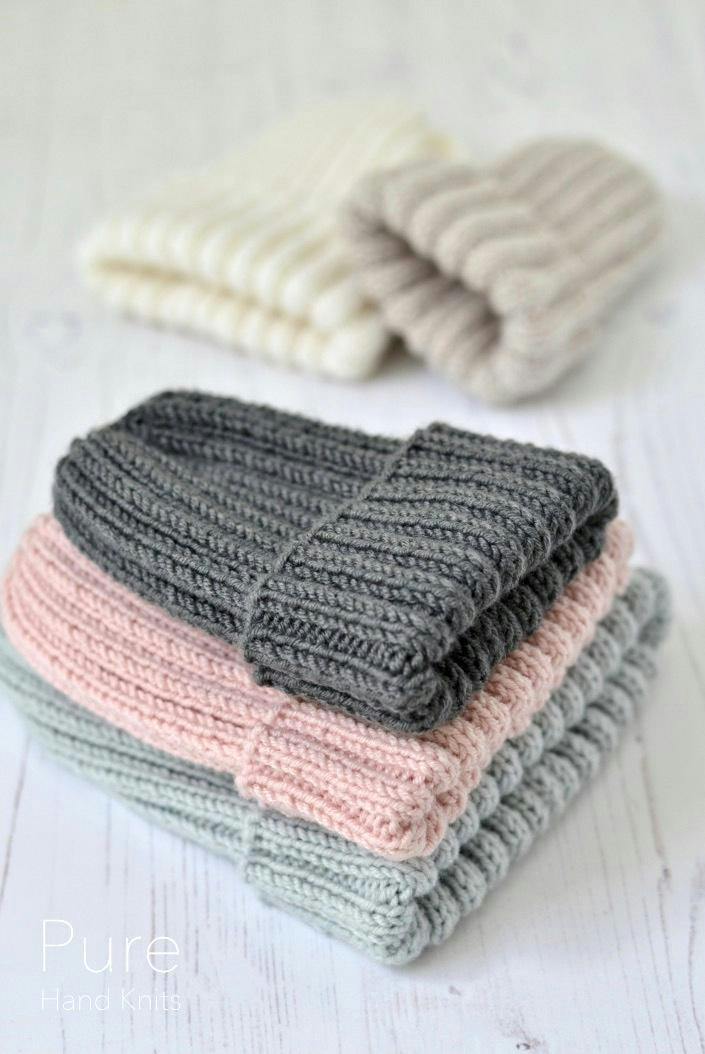
Mikki DK Simple Rib Hat
Mikki DK Simple Rib Hat by Pure Hand Knits keeps the stitch pattern simple and gives you separate instructions for knitting flat or in the round. The brim can be folded for a double-layer cuff or left tall. Sizes run from 0–3 months to adult.
The designer specifies smaller needles than the usual DK recommendation to keep the rib elastic. Swatch in rib and check the finished measurements before choosing a size; one reviewer found the hat larger than expected.
One of the yarns used for the photographed samples. Choose your size in the PDF and check tension before buying yarn.
2. Cables, without committing to knitting in the round
“Loved this pattern! Instructions were easy to follow and really well set out. I love the fact that the pattern gives instructions for using two needles or in the round knitting.”
5/5 stars · Verified buyer · 2018-04-03
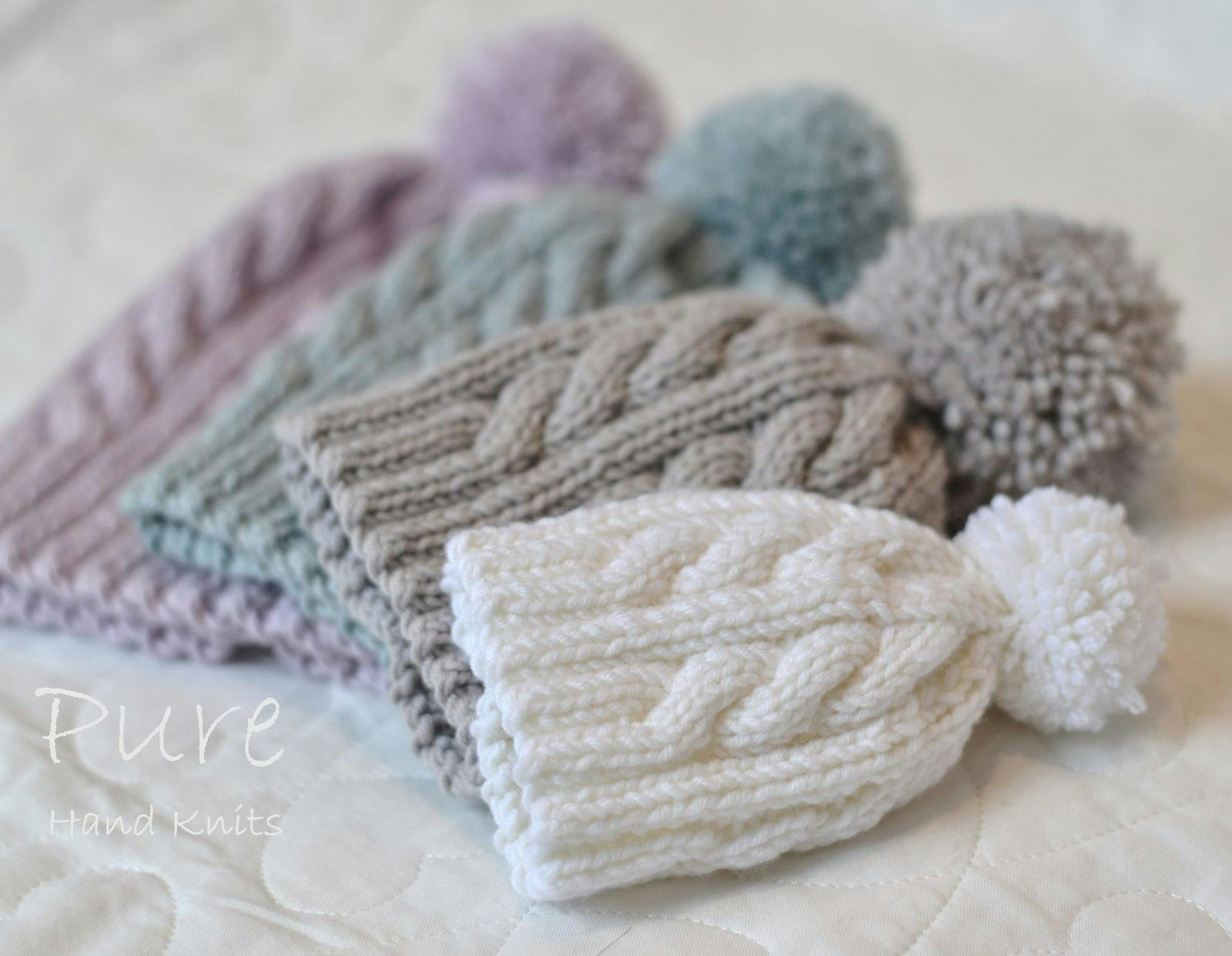
Oscar Cabled Pompom hat
Oscar Cabled Pompom hat by Pure Hand Knits is a next step when you want more texture than plain rib. The aran-weight pattern includes separate row-by-row instructions for straight needles and knitting in the round, in sizes from newborn to adult.
Choose the construction you already feel comfortable with, then concentrate on the cables. Follow the needle sizes and tension in the PDF rather than treating every aran yarn as interchangeable.
Yarn: Debbie Bliss Cashmerino Aran
An alternative yarn explicitly suggested by the designer. Choose your size in the PDF and check tension before buying yarn.
3. An in-the-round cable project with written and charted instructions
“This is the first time I have knitted with a circular needle and it was so easy and the pattern was easy to read and best of all I got a brilliant new hat. Definitely recommend”
5/5 stars · Verified buyer · 2021-02-04
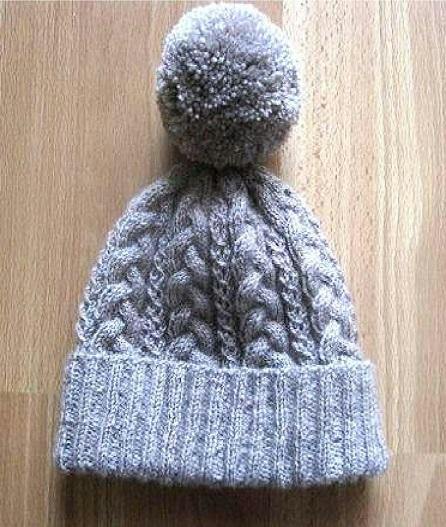
Super Cosy Cabled Beanie
Super Cosy Cabled Beanie by Suzie Sparkles has a turned-up ribbed brim, cables and an optional pompom. It is worked in the round on double-pointed or circular needles. You get both a colour chart and round-by-round written instructions, with child, small-adult and large-adult sizes.
This buyer's first circular-needle project went well, but the designer rates the pattern intermediate: it asks you to knit in the round and work cables. It is a step up, not a promise of an effortless first hat.
Listed among the pattern's yarn options. Choose your size in the PDF and check tension before buying yarn.
4. A playful crown-shaped hat on straight needles
“Very easy to follow instructions together with detailed photos. I have now made two beanies and I’m over the moon with the finished product!”
5/5 stars · Verified buyer · 2020-11-16
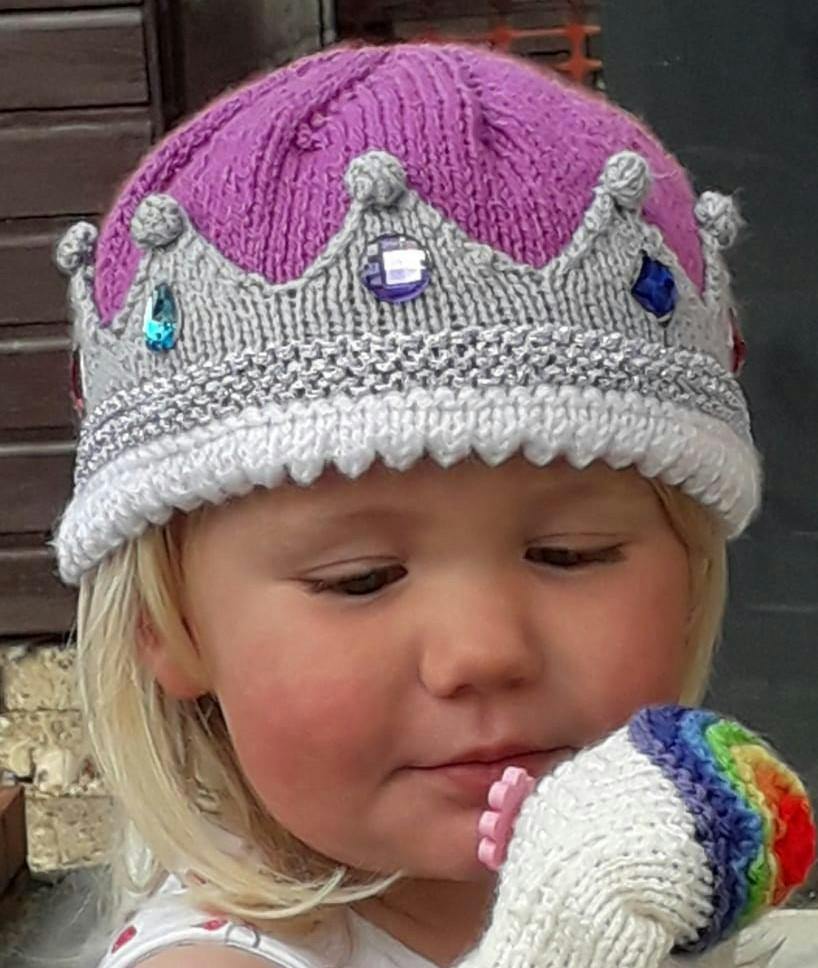
The Royal Beanie
The Royal Beanie by LCMknits puts a crown around a DK hat, using knit and purl stitches on straight needles. The PDF includes row-by-row instructions and explanatory photographs, with four sizes from baby/toddler to adult.
This is the decorative, intermediate pick rather than the easiest beginner option. Reviews are mixed on the edging and sizing, so read the instructions and check the brim measurements first. For young children, omit loose decorative jewels.
The pattern's materials list includes Magenta and Silver; check the PDF for the additional trim requirements. Choose your size in the PDF and check tension before buying yarn.
What to knit next
Once you've made one hat you've got every skill in a beanie, a cowl, a pair of mittens and most baby knits. Good next steps:
- Free hat and beanie knitting patterns — 1,876 free patterns, including bobble hats, slouches and cables for when plain stocking stitch stops being interesting.
- Free baby hat knitting patterns — 303 patterns, and a baby hat takes about two hours.
- Free knitting patterns for beginners — 4,469 patterns filtered to easy.
- How to knit a scarf — if you want a second project with no shaping at all.
- How to knit, step by step and three ways to cast off — the underlying techniques, in detail.
FAQ
Can I knit a hat on straight needles? Yes — method one above. You'll have a seam up the back, which is invisible in a textured or variegated yarn and slightly visible in a smooth solid.
How long does it take to knit a hat? In chunky yarn, three to four hours for an experienced knitter and about two evenings for a beginner. In aran, roughly double.
How much yarn does a hat take? One 100g ball of chunky, or 100–120g of aran, for an adult hat. A baby hat takes 50g or less, which makes hats the best use of leftover balls you have.
What size needles for a hat? 6mm for chunky, 5mm for aran, and one size smaller than that for the rib if you want a tighter brim.
Do I need double-pointed needles? Only for the last 20 stitches of a hat knitted in the round, and magic loop on your circular is an alternative. For a flat hat, no.
Can a complete beginner knit a hat? Yes, and we'd argue it's a better first project than a scarf: fewer stitches per row, finished faster, and it teaches shaping.

How to Choose Colours for a Crochet Blanket: Three Palettes, One Pattern
How to choose colours for a crochet blanket: three Paintbox Yarns palettes for one stri...
Continue reading How to Choose Colours for a Crochet Blanket: Three Palettes, One Pattern
Aida 14, 16 or 18 Count: How Big Will Your Finished Cross Stitch Be?
Work out your finished cross stitch size on 11, 14, 16 or 18 count Aida, with a size ta...
Continue reading Aida 14, 16 or 18 Count: How Big Will Your Finished Cross Stitch Be?


