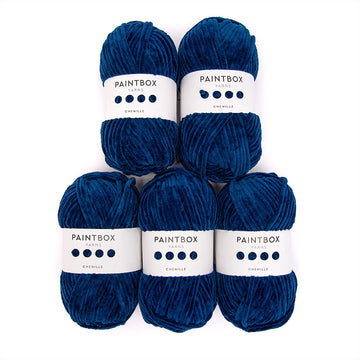
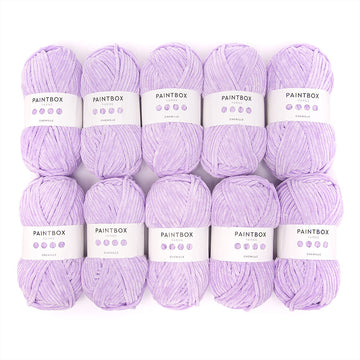
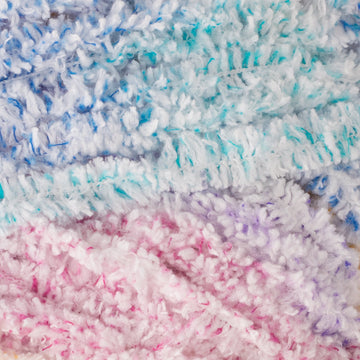
Velvet in a ball
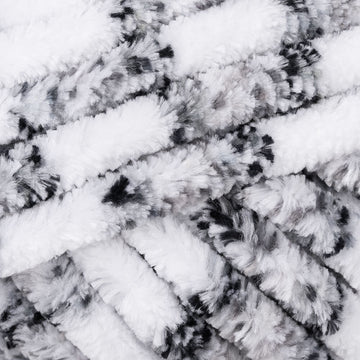
Chenille is constructed rather than simply spun. Short lengths of fibre are trapped between two twisted core threads and stand out at right angles, creating a dense pile all the way round the strand. The technique dates back to the 18th century in fabric weaving and translates surprisingly well to yarn. What you get is a strand that reflects light like velvet, feels extraordinarily soft, and produces plush stitches with almost no visible definition – the pile fills the gaps and the fabric reads as a solid surface rather than a set of loops. That is the whole appeal, and also the main constraint: stitch patterns disappear into chenille, so this is a yarn for plain fabric and good colour, not for cables and lace.
What chenille is best for
- Baby blankets: soft, warm and light. The most popular use by a wide margin.
- Cushions and floor poufs: the pile hides seams and looks like an expensive shop-bought finish.
- Amigurumi and cuddly toys: chunky chenille makes fast, huggable toys with a plush surface.
- Cowls, hats and mitts: quick winter accessories in one or two balls.
- Throws and bed runners: big, plush, and finished in a weekend on a large hook.
Working with the pile
Chenille has two habits that catch people out. The first is worming: loops of yarn work their way out of the fabric and stand up in little curls, which happens when the tension is too loose. Work firmly, go down a hook or needle size from what the thickness suggests, and choose a dense stitch – single crochet or moss stitch rather than open trebles. The second is that mistakes are hard to see and hard to undo. The pile catches on itself, so frogging is unpleasant and can shed fibre. Count your stitches at the end of every row or round, use markers generously, and check the edges as you go rather than discovering a drift twenty rows later.
Hooks, needles and quantity
Blunt, smooth tools help enormously: sharp points split the core threads and pull the pile. Most chenille sits in the super chunky range, so a 6 to 10mm hook or needle is typical, but always start from the ball band. Because it is thick, a project needs fewer metres than you would expect but the balls run out quickly, so plan by metreage from the pattern rather than by eye. A baby blanket in super chunky chenille might take 400 to 700 metres; a cushion cover far less. Keep to one dye lot, as the pile shows subtle colour differences more clearly than a flat yarn does.
Care and durability
Most chenille yarns are polyester or acrylic based and machine washable, which is the reason they suit nursery items. Wash cool in a mesh bag and dry flat, and never press with a hot iron – heat flattens the pile permanently and takes the velvet look with it. Expect some shedding in the first wash; that is the loose pile fibres and it settles. For toys and blankets that will be dragged around, a firmer tension pays off twice: the fabric wears better and it worms less. Weave ends in with a large blunt needle and split the strand if it is too thick to pass through neatly.
Chenille yarn questions
Why does my chenille yarn worm?
Almost always because the tension is too loose. Go down a hook size and use a dense stitch pattern.
Is chenille yarn safe for babies?
It is popular for baby blankets because it is soft and washable. Work at a firm tension so the pile is secure and avoid loose, open stitches.
What hook size do I use with chenille?
Follow the ball band, then consider going down one size for a firmer fabric. Most chenille is super bulky.
Can you knit with chenille as well as crochet?
Yes. Knitting gives a smoother plush fabric; crochet gives a firmer one that worms less.
Anything similar to try?
Look at super chunky yarn or acrylic yarn.
Where to go next
Chenille is the yarn behind plush blankets and amigurumi — see super chunky crochet patterns and free crochet patterns for the makes it suits. Similar pile and texture: polyester yarn and ribbon yarn. By weight it is almost all super chunky and chunky.