What t-shirt yarn is and why it behaves differently
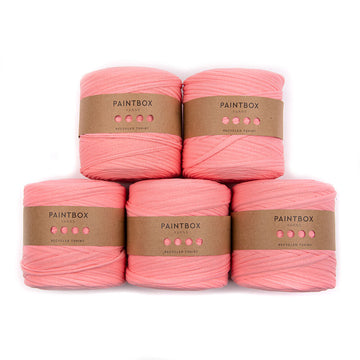
T-shirt yarn is jersey fabric cut into a continuous strip, usually from surplus or offcut cotton jersey, and wound into a large ball or bobbin. It is not spun, so it has none of the twist you rely on in ordinary yarn. Instead it stretches lengthways, curls in on itself as you pull it, and flattens under tension. That combination is exactly what makes it good for structural items — the flattening gives you a wide, solid stitch, and the lack of memory means a finished basket holds its shape instead of springing back.
What to make with it
- Baskets and storage tubs: the classic use. Worked in a spiral of double crochet, the fabric is stiff enough to stand up unaided.
- Bags and totes: hard-wearing and surprisingly strong, with handles reinforced by working extra rounds.
- Rag rugs and bath mats: heavy, washable and quick, particularly in a simple oval or rectangle.
- Coasters and placemats: single-evening projects and a good way to test a new colour.
- Plant pot covers and cushion fronts: chunky texture that reads as deliberate rather than fussy.
Hooks, needles and hands
Use a much larger hook than the fabric thickness suggests — commonly somewhere between 8mm and 12mm, depending on how the strip is cut. Too small a hook and every stitch becomes a fight; too large and a basket will sag. Aluminium and smooth plastic hooks glide better than wood with this fibre, and a hook with a broad, comfortable handle is worth having, because t-shirt yarn is heavy work for the hands. Take frequent breaks; it is genuinely more tiring than DK, and wrist strain is the main reason people abandon a large rug halfway.
Working with recycled fabric strips
Expect variation. Because the yarn is cut from real fabric, thickness, stretch and shade can shift within and between balls. Treat it like a hand-dyed yarn: if you are making something large, alternate between two balls every couple of rounds so any difference blends across the piece rather than appearing as a hard line. Joins are easiest done with the loop-through-slit method rather than knots, which keeps the join flat and invisible. Keep your tension deliberately even and slightly loose; the fabric will not forgive being yanked, and over-tight stitches make the finished item cup.
Sustainability and knitting with it
Most t-shirt yarn is made from jersey that would otherwise be waste, which is a large part of its appeal. It can be knitted as well as crocheted, though knitting is less common because the fabric does not compress as neatly on a needle; if you do knit with it, use a short, thick circular needle and expect the finished piece to have far more drape than a crocheted one. Arm knitting is another option for very quick, very chunky rugs and throws.
Washing and care
Cotton jersey items can generally be machine washed cool and reshaped damp, which is why t-shirt yarn baskets and bath mats survive real household use. Dry flat and pull the piece back into shape while it is still wet — a basket in particular wants its base flattened and its sides pushed upright before drying. Avoid tumble drying, which can shrink and distort the fabric unevenly. If a basket softens over time, a round or two of firm double crochet added to the rim will stiffen it up again.
T-shirt yarn questions
What hook size do I need for t-shirt yarn? Most projects use roughly 8mm to 12mm. Start large, work a small swatch, and go down a size if the fabric feels floppy.
Is t-shirt yarn suitable for beginners? Yes, in short projects. The stitches are large and easy to see, but the weight makes big items tiring, so start with a coaster or small basket.
Can you knit with t-shirt yarn? You can, using large needles, though it is more commonly crocheted because crochet gives the stiffness that baskets and bags need.
How much do I need for a basket? A small storage basket typically takes one large ball; check the pattern's stated quantity, as strip width varies between suppliers.
Can it be washed? Usually yes, cool and gentle, then reshape while damp and dry flat.