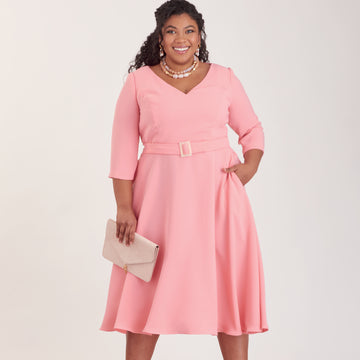
Choosing a pattern you will actually finish
The pattern envelope tempts you with the photograph, but the useful information is on the back: the fabric suggestions, the yardage table, the notions list and the finished garment measurements. Read those first. A pattern that calls for a stable woven and interfacing is a completely different evening's work from one written for a drapey jersey. If you are early on, the shortest route to a wearable garment is a simple top or elasticated-waist trousers in a stable cotton, where the fabric behaves and the fit is forgiving.
Getting the size right before you cut
Sewing pattern sizes have nothing to do with shop sizes, and using your usual number is the most common source of disappointment. Measure your bust, waist and hips honestly, over the underwear you will wear with the garment, and choose your size from the pattern's own chart. If your measurements straddle two or three sizes, grade between them — most patterns have clearly marked lines to make that possible. Then compare the finished garment measurements with the body measurements to see how much ease the designer intended: a difference of a few centimetres is a fitted garment, fifteen or more is deliberately loose. Cutting the right size beats any amount of clever alteration afterwards.
Fabric, notions and preparation
- Prewash your fabric exactly as you will wash the garment, or the first laundry will shrink it out of fit.
- Match the recommended fabric type — woven patterns rely on fabric that does not stretch, and knit patterns rely on fabric that does.
- Buy the notions listed: interfacing, zips, buttons, bias binding and matching thread, before you start rather than mid-project.
- Cut on grain, lining up the grainline arrow with the selvedge; a twisted grain makes a leg or a bodice hang crookedly.
- Transfer the markings: notches, darts and dots are what make the pieces fit together in the right order.
Making a toile, and when it is worth it
A toile is a practice version in cheap fabric of similar weight. For a simple top or a loose dress, it is often unnecessary. For a fitted bodice, a tailored jacket or trousers — the three things most likely to need adjustment — it saves the good fabric and shows you exactly where to add or remove length before you cut. You only need to make the parts that affect fit, so a bodice toile without sleeves or facings is usually enough to answer the question.
PDF patterns and printing at home
Instant download patterns are printed at home on A4 and taped together, or sent to a copy shop for a single large sheet. Whichever you choose, print the test square first and measure it; if it is not exactly the stated size, the scaling in your print dialogue is wrong and the whole pattern will be out. Many PDFs are layered, letting you switch off every size but yours before printing, which makes tracing and cutting far less confusing.
Finishing and looking after what you make
Press at every stage — seams, darts, then again after the next seam. Pressing as you go is the single clearest difference between a homemade and a handmade finish. Neaten raw edges with an overlocker, a zigzag or French seams to stop fraying in the wash. Hems can be machined, blind-hemmed or hand-stitched depending on how visible you want the stitching. Once finished, wash the garment as you prewashed the fabric, and keep the leftover scraps for patching or facings.
Sewing pattern questions
Which sewing patterns are best for beginners? Simple tops, elasticated trousers, tote bags and loose dresses in stable woven cotton, with few pattern pieces and no zip.
How do I choose my size? From your own measurements against the pattern's size chart, not your high-street size.
Can I print a PDF pattern at home? Yes, on A4 with scaling off. Always check the printed test square before assembling.
How much fabric do I need? The yardage table on the pattern gives it by size and fabric width; buy a little extra for directional prints and checks.