Knitted elephants, and what makes them work
An elephant is one of the easier animals to knit well, because the shape forgives a little wobble and the details, the ears and trunk, are knitted separately and sewn on last. The patterns here range from small, quick projects to larger cuddly toys, and include mummy and baby pairs worked from the same instructions at two gauges. Several are written for fluffy chenille-style baby yarns such as King Cole Yummy, which hides uneven stitches completely, and others for smooth DK acrylic like Deramores Studio DK, where the shaping shows more crisply. Berroco's Harper the Elephant and Red Heart's Emily and Edward pair are among the designs available as downloads.
Skill level and what you'll be doing
Most of these are stocking stitch worked either flat and seamed or in the round on double-pointed needles, with increases and decreases to shape the body and head. If you can knit, purl, increase, decrease and sew a mattress stitch seam, you can knit an elephant. The genuinely fiddly part is not the knitting; it is the making up. Getting two ears to match, positioning them symmetrically, and setting the trunk so it does not droop sideways takes more care than the body ever did.
Tips that make a real difference
- Knit tighter than usual. Go down a needle size or two from the ball band so stuffing cannot push through the fabric.
- Stuff in small pieces. Handfuls create lumps; teased-out wisps packed gradually give a smooth body.
- Stuff the trunk with a knitting needle or the blunt end of a crochet hook, a little at a time, and shape it as you go.
- Pin before you sew. Pin both ears, stand the toy on a table, walk away, then look again before stitching.
- Embroider the eyes rather than using safety eyes for any toy going to a baby, and keep the yarn tail well anchored inside.
Yarn and quantity
These are small projects, and most use well under 100g, often a single ball plus scraps for the inner ear or a blanket. That makes them a good use of leftovers, but do check fibre: soft, washable DK is the right choice because a toy given to a child will be dragged everywhere and washed often. Acrylic and acrylic-nylon baby yarns are ideal. Avoid anything scratchy, anything that sheds heavily, and anything hand-wash-only unless the recipient is a collector rather than a toddler. Buy your stuffing generously; a proper toy takes more than people expect, and understuffing is the most common reason a knitted elephant looks sad.
Gifting and safety
Knitted elephants are new-baby presents above almost anything else, and they work equally well as a christening gift, a first birthday present or a nursery decoration. For a baby, keep it simple and safe: embroidered features only, no buttons, no ribbons long enough to loop, and every end woven in firmly rather than knotted. Use a washable polyester toy stuffing that meets safety standards. If you are making the mummy and baby pair, they photograph beautifully together and make a more substantial gift than a single toy.
Care and finishing
Before stuffing, weave in ends on the inside of the piece where they will be trapped forever. Close the final seam with a ladder stitch so the join disappears. To wash, hand wash in lukewarm water, squeeze gently, press out the water in a towel and dry flat away from direct heat; the stuffing takes a day or two to dry through, so do not rush it back to a child.
Elephant pattern questions
How much yarn does a knitted elephant take? Usually well under a 100g ball of DK, plus small amounts for contrast ears.
Are these patterns for beginners? If you can increase, decrease and seam, yes. The making up is the hardest part, not the knitting.
Do I need double-pointed needles? Only for designs worked in the round. Many are knitted flat and seamed.
Which yarn is best? A soft washable DK. Fluffy chenille yarns hide uneven tension; smooth yarns show shaping more clearly.
Are they safe for babies? They can be, if you embroider the features, use safe toy stuffing and secure every end.


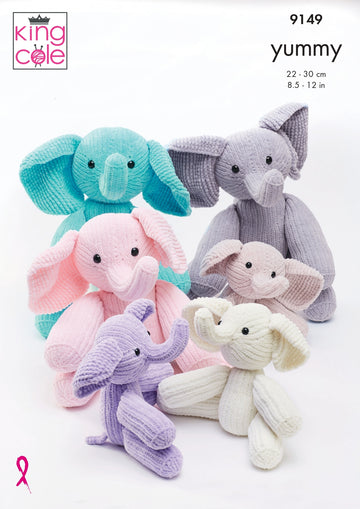 Elephant Knitted in King Cole Yummy - 9149 - Downloadable PDF
$4.45
Elephant Knitted in King Cole Yummy - 9149 - Downloadable PDF
$4.45
 Mummy and Baby Elephant in Deramores Studio DK - Downloadable PDF
$4.25
Mummy and Baby Elephant in Deramores Studio DK - Downloadable PDF
$4.25
 Elephant in Sirdar Touch & Hayfield Bonus DK - 2487 - Downloadable PDF
$5.75
Elephant in Sirdar Touch & Hayfield Bonus DK - 2487 - Downloadable PDF
$5.75
 Elephant Deramores Studio DK in Deramores - Downloadable PDF
$4.25
Elephant Deramores Studio DK in Deramores - Downloadable PDF
$4.25
 Eddie the Elephant in Deramores Studio DK Acrylic - Downloadable PDF
$4.25
Eddie the Elephant in Deramores Studio DK Acrylic - Downloadable PDF
$4.25
 Emily & Edward Knit Elephants in Red Heart Amigurumi - LM6277 - Downloadable PDF
$0.00
Emily & Edward Knit Elephants in Red Heart Amigurumi - LM6277 - Downloadable PDF
$0.00
 Noahs Ark - Elephants in Sirdar Snuggly Baby Bamboo DK
$0.00
Noahs Ark - Elephants in Sirdar Snuggly Baby Bamboo DK
$0.00
 Berroco Harper the Elephant PDF
$0.00
Berroco Harper the Elephant PDF
$0.00


