A designer's eye applied to plain knitting
Erika Knight came to hand-knitting from fashion design — consulting for Italian and British labels, teaching, and developing knitwear for high-street brands — and it shows in the shapes rather than in the stitch counts. These are not busy patterns. The typical Erika Knight design is a simple silhouette in a single texture: a boxy jumper with dropped shoulders, a straight cardigan with a deep band, a chunky hat that relies on one good rib. What makes them worth knitting is proportion. Sleeve length, body width and neck depth are worked out so the finished piece hangs the way a professionally designed garment hangs, which is exactly the part most beginner-friendly patterns get wrong.
The yarns behind the designs
Erika now concentrates on British-made, ecologically responsible yarn, and the patterns are written for that character: undyed and naturally shaded wools, chunky singles, and crisp 4 plies. Practically, that means a fabric with grip and bounce rather than slither and shine. Chunky singles knit up very fast and forgive uneven tension because the stitches are large; they also pill more readily at cuffs and underarms, so a slightly firmer tension pays off. The finer wools give clean stocking stitch and hold a rib edge for years. If you substitute, match the ply structure as well as the weight, or a design that depends on stitch definition will read as mush.
Where to start
- First project: a chunky hat or a garter-stitch scarf. One skill, one evening, immediate proof that the yarn is worth it.
- First garment: a drop-shoulder jumper in chunky — four straight pieces, minimal shaping, seamed at the end.
- Next: a cardigan with button bands, which introduces picking up stitches evenly along an edge.
- For the house: cushion covers and throws, where you can swatch a texture at full scale.
- More involved: fine-gauge 4 ply pieces with set-in sleeves, a slower knit with a much more tailored result.
Tension and sizing on a minimal garment
Simple shapes are unforgiving about width because there is no shaping to disguise an error. Knit a 15cm swatch, wash it, dry it flat and measure the middle. Then choose your size by finished chest measurement, not by clothing size: measure a jumper you already like across the chest, double it, and pick the nearest figure in the pattern. Erika's designs often carry generous positive ease by intent, so the number in the pattern may be 15cm larger than your body and still be correct. Read the schematic before you assume it is a misprint.
Quantities and buying
Work to the metreage the pattern lists rather than the ball count, since chunky singles and 4 plies differ enormously in length per 50g. A chunky adult jumper often falls between 700 and 1,200 metres; a hat is one or two balls; a throw can easily run past 1,500. Keep to one dye lot — natural, undyed shades vary between batches by fleece as much as by dyeing, which is part of the appeal and a problem if half a sleeve is noticeably paler.
Finishing so it looks designed
Block pieces flat to the schematic measurements before seaming; woollen-spun yarns settle and even out dramatically with a wet block. Seam with mattress stitch in the same yarn, splitting a chunky single into fewer plies if the seam looks bulky. Sew buttons on with a shank so the band does not pucker. Wash by hand in lukewarm water with a wool detergent, press the water out in a towel and dry flat, reshaping the ribs while damp.
Erika Knight pattern questions
Are Erika Knight patterns suitable for beginners? Many are. The shapes are simple, and hats, scarves and drop-shoulder jumpers need very few techniques.
Do I have to use her own yarn? No, but match tension, metreage and ply structure. The designs rely on the fabric behaving a particular way.
How are the patterns delivered? As PDF downloads you can print and annotate.
Why does the finished chest measurement look so large? Because the ease is deliberate. Check the schematic and the model's stated size before sizing down.
Which weight knits fastest? Chunky, comfortably. A chunky hat is an evening; the same hat in 4 ply is a week.


 Constance Cowl in Erika Knight British Blue 100 - Downloadable PDF
$6.00
Constance Cowl in Erika Knight British Blue 100 - Downloadable PDF
$6.00
 Dora Sweater in Erika Knight British Blue 100 - Downloadable PDF
$6.00
Dora Sweater in Erika Knight British Blue 100 - Downloadable PDF
$6.00
 Pretender Shawl in Erika Knight Fur Wool - Downloadable PDF
$6.00
Pretender Shawl in Erika Knight Fur Wool - Downloadable PDF
$6.00
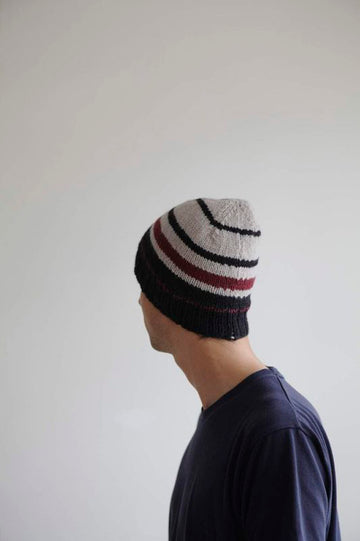 Stripe Beanie Hat in Erika Knight Vintage Wool
$0.00
Stripe Beanie Hat in Erika Knight Vintage Wool
$0.00
 Furry Welly Toppers in Erika Knight Fur Wool and Maxi Wool
$0.00
Furry Welly Toppers in Erika Knight Fur Wool and Maxi Wool
$0.00
 Colour Block Fur Scarf in Erika Knight Fur Wool
$0.00
Colour Block Fur Scarf in Erika Knight Fur Wool
$0.00


