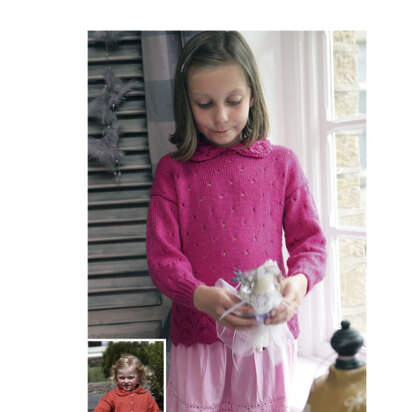
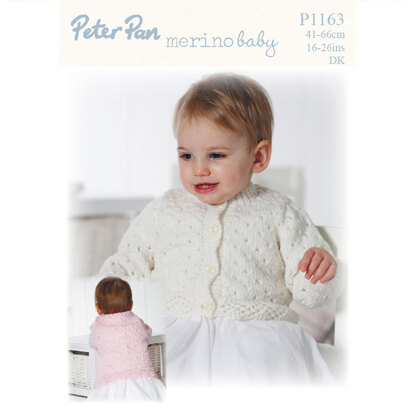
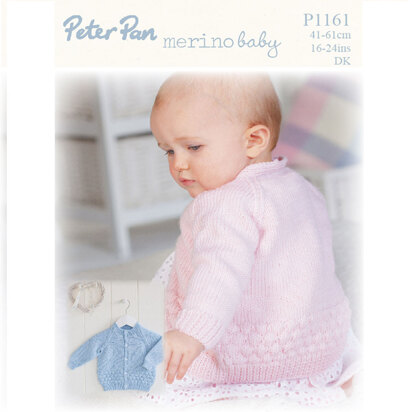
The baby range British knitters grew up with
Peter Pan patterns have a very particular character: traditional shapes, careful sizing and yarns chosen to be soft against new skin. If you learned to knit from a leaflet handed down by a grandmother, there is a fair chance it had a Peter Pan cover on it. The designs favour the classics — matinee jackets, round-neck and V-neck cardigans, hooded jackets, all-in-one pramsuits, booties, bonnets, mittens and blankets — and they are written in plain, unfussy language with the whole size range in one document. Patterns are supplied as PDF downloads, so you can print the pages you need and keep the file for the next baby.
How the sizing works
Peter Pan leaflets typically start smaller than most modern patterns, often from premature and newborn sizes, and run up in increments through the first years. The sizes are given as actual chest measurements with the ease already built in, which is far more reliable than an age label. A rough guide: about 41cm chest for premature, 46cm for newborn, 51cm at three months, 56cm at six months and 61cm around a year. The most useful gift size is 3–6 months, because newborn knits are outgrown before they are properly worn. Sleeves look short on the page and are almost always correct — babies' arms are shorter relative to their bodies than adults expect.
Choosing yarn
- DK — the everyday choice for cardigans, jackets and hats. Knits at a sensible pace and gives a practical fabric.
- 4 ply — the traditional weight for matinee jackets, shawls and christening pieces, with the fine, heirloom look.
- Soft washable blends — the priority for anything a parent will wash weekly. Check the ball band for a wool-cycle or 40°C symbol.
- Avoid — anything with a long fluffy halo near a newborn's face, and coarse rustic wools against the skin.
Quantities and buying
Baby garments are wonderfully economical. A newborn cardigan in DK is often two or three 50g balls; a 4 ply matinee jacket can be as little as two; booties and mittens come out of the leftovers. Buy to the metreage given for your size rather than the ball count, and get one extra ball if you plan to knit the largest size or lengthen the body. Keep the spare — baby knits get snagged, and a matching repair is worth having.
Techniques in these patterns
The staples are simple, which is why so many people learned garment knitting from them: raglan or set-in sleeves worked flat in pieces, garter and moss stitch borders, simple eyelet lace rows, picot edges and buttonholes worked in a band. The one part worth practising is picking up stitches for a neckband evenly — roughly three stitches for every four rows along a vertical edge, and one for one across a cast-off. A wobbly neckband is the only thing that gives away an otherwise beautiful baby cardigan.
Safety, finishing and washing
Sew buttons on with doubled strong thread and check them before every wear once a baby starts chewing. Skip ribbons and cords at the neck; use buttons or a knitted i-cord instead. Weave ends in securely along the stitch line and trim them close so nothing can wrap around a finger or toe. Seam with mattress stitch in the project yarn for a flat, non-rubbing join. Wash finished pieces on a wool cycle or by hand at 30°C, roll in a towel and dry flat, then include the ball band with the gift.
Peter Pan pattern questions
How are the patterns supplied? As PDF downloads you can print at home and keep in your account.
What size should I knit for a new baby? The 3–6 month size gets the most wear. Newborn sizes are outgrown fast.
Which weight are most Peter Pan patterns? DK and 4 ply, with DK the faster and more practical choice for everyday wear.
Can I use a different yarn? Yes, if you match the tension and metreage and choose something soft and washable.
Are they suitable for beginners? Booties, hats and simple garter-edged cardigans certainly are; matinee jackets need a little more confidence.