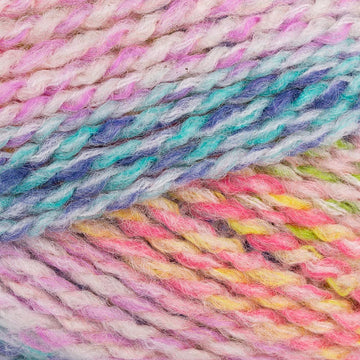
What Nako yarn is like to work with
Nako's reputation rests on dyeing. The Turkish mill has been running since 1962 and its self-striping and gradient yarns produce long, clean colour changes rather than the muddy transitions cheaper printed yarns can give you, which is why they turn up so often in single-skein shawls and striped blankets. The plied acrylics have a slightly springy, rounded handle, so stitches sit evenly and ribbing keeps its shape; the baby-weight yarns are softened in finishing and are gentle enough against a newborn's neck. Because most of the range is machine washable, Nako is a sensible pick for anything that will be worn hard, sat on, or handed to a toddler.
Choosing a Nako yarn for your project
- Blankets and afghans: a DK or aran acrylic in a solid shade, bought in one dye lot, with a self-striping ball for the border.
- Baby garments: the soft baby yarns, which wash and dry without special handling – the main thing new parents actually want.
- Amigurumi and toys: a firm, smooth yarn worked a hook or two below the ball band tension so the stuffing does not show through.
- Shawls and scarves: a gradient or self-striping ball, worked in one piece so the colour sequence is not interrupted by seams.
- Charity and volume knitting: plain solids, where price per metre matters more than fibre content.
Tension, hooks and needles
Always trust the ball band on a brand you have not used before, then check it against your pattern. A Nako DK will usually want 4mm needles and land near 22 stitches to 10cm, and an aran nearer 18 stitches on 5mm, but the finishing on a yarn changes how it blooms. Knit a 15cm square, wash it exactly as you intend to wash the finished piece, let it dry flat and then measure the middle rather than the edges. Acrylic in particular relaxes when it is washed, so a swatch measured straight off the needles will flatter you and the jumper will grow later.
How much to buy
Buy to metres, not to balls. A baby blanket in DK typically needs somewhere around 800 to 1,200 metres, an adult jumper considerably more, and a hat or a pair of mitts can come out of a single ball with yarn to spare. Keep every ball in the same dye lot; even well-controlled dyeing shifts slightly between batches and the join will show as a faint stripe across a blanket. If you are working a gradient, plan the layout of the balls before you cast on so the colour sequence flows the way you want it to.
Care, blocking and finishing
Acrylic and acrylic blends will not block in the way wool does. Wet blocking relaxes them a little, but the shape you knit is broadly the shape you keep, so pay attention to tension rather than hoping to stretch a piece into fit. Steam blocking works if you hold the iron well above the fabric and never touch it – direct heat kills the crimp and leaves the fabric limp and shiny, and that cannot be undone. Wash finished items on a cool machine cycle in a mesh bag, dry flat, and weave in ends along the line of the stitches so they do not work loose in the wash.
Nako yarn questions
Is Nako yarn soft enough for babies?
The baby-specific yarns in the range are finished to be soft next to the skin and are machine washable, which is the practical test for baby gifts. Swatch first if you know the recipient has sensitive skin.
Can I substitute Nako for another yarn in a pattern?
Yes, provided the ball band tension and the metres per ball are close. Match tension first, then check total metreage for your size before buying.
Does Nako yarn pill?
Smooth plied yarns hold up well; loosely spun and brushed yarns pill more with friction, especially at cuffs and under arms. A slightly firmer tension helps.
What else should I look at?
For a like-for-like comparison see acrylic yarn, or browse everything in cheap and value yarns.