Why buy yarn in a pack
Colourwork projects have an awkward arithmetic problem. A granny square blanket in twelve shades might use 30g of each, but yarn is sold in 50g and 100g balls, so buying singly leaves you with most of a ball of eleven colours you did not choose and cannot easily use. A colour pack solves that by supplying small coordinated quantities in one purchase, usually in shades that have been chosen to sit together. It also removes the hardest part of a colourwork project, which is not the stitching but deciding whether that mustard really works next to that teal.
Packs here cover cotton, acrylic and wool blends, in weights from DK through aran to chunky, with palettes ranging from bright rainbow sets to muted neutrals and single-colour gradients.
What to make from a pack
- Granny square and motif blankets: the classic use. Each square takes a few grams, so a pack goes a very long way.
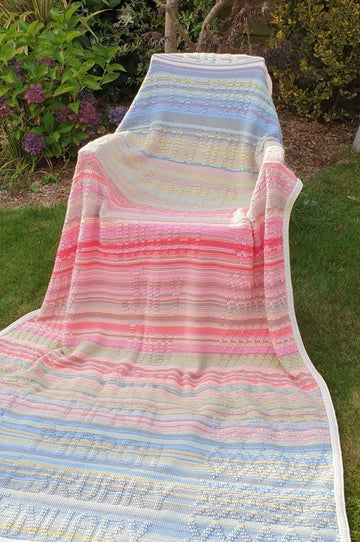
- Striped blankets, scarves and jumpers: where you want colour changes but not a full ball of each shade.
- Fair Isle and stranded knitting: contrast colours are used in tiny amounts, which is exactly what a pack supplies.
- Amigurumi and toys: small animals need several colours and almost no quantity of any of them.
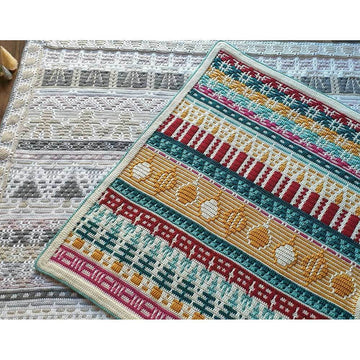
- Tapestry crochet, colour pooling and gradient shawls: where the shade order is the entire design.
Choosing a palette that works
Look at the tonal value of the shades, not just the hue. Photograph the pack and turn the picture to black and white: if all the colours turn the same grey, your finished blanket will look flat however pretty the individual balls are. A good set has genuine light and dark in it. If your project needs a unifying element, add a single neutral, cream, charcoal or a deep denim, and use it for every join, border or alternate square. That one decision does more for a scrappy blanket than any amount of careful shade matching.
Quantities, tension and joining
Check the weight of each ball or mini skein in the pack and compare it against the metres your pattern needs per colour before you start, particularly for a blanket where the border alone can swallow a whole shade. Work a tension square in the pattern stitch, because crochet in particular varies enormously between makers and a square that is 1cm out becomes 20cm over a blanket. Keep every colour at the same tension by holding the yarn consistently, and weave ends in as you go: a twelve-colour blanket left to the end can hide several hundred ends, which is where these projects go to die.
Care and storing what is left
Wash according to the ball band and keep one band from each pack, since a mixed-fibre project has to be treated as the most delicate fibre in it. Store leftovers together in a labelled bag rather than scattering them; the remaining scraps from a colour pack are the perfect start for the next set of squares, bunting or a scrap blanket.
Colour pack questions
How much yarn is in a colour pack? It varies by pack. Check the number of balls and the weight of each on the product page before matching it to your pattern.
Are packs cheaper than buying individually? They are designed to give you usable small quantities of several shades rather than surplus full balls, which is where the saving usually lies.
What can a beginner make from a pack? A granny square blanket. Each square is small, repeatable and finished in minutes.
Can I mix packs? Yes, as long as the weights and fibres match so the fabric and washing instructions stay consistent.
Will the shades vary between packs? Dye lots can differ, so buy everything for one project together.