Cardigan styles for little ones
Traditional matinee coats with lace edging, plain stocking stitch cardis, cabled jackets, hooded designs, wrap-over styles and modern seam-free top-down shapes: this collection covers all of them, free to download as printable PDFs. Most patterns cover a run of sizes in one file, commonly newborn, 0-3 months, 3-6 months and upwards to two years, with finished chest measurements listed for each. Yarn weights run from 4 ply for fine heirloom knits through DK, which is the everyday favourite, to chunky for quick winter jackets.
One piece, top-down, or knitted flat and seamed
The construction is worth choosing deliberately. One-piece and top-down cardigans are knitted from the neck down with raglan or yoke increases, so there is almost no sewing at the end and you can try the garment against the baby as you go. Flat, seamed patterns give you two fronts, a back and two sleeves, all knitted on straight needles, which is ideal if circular needles are not your thing and makes each piece portable. Traditional matinee coats are often knitted in one piece to the underarm, then divided, which is a neat halfway mark.
Sizing and fit
- Babies grow astonishingly fast, so a size up is rarely wasted. If in doubt, knit 3-6 months.
- Think about the season the size will fall in: a chunky cardigan finished for a July baby is best knitted in a nine-month size.
- Check the finished chest measurement rather than the age on the label; ease varies a lot between designers.
- Sleeves with turn-back cuffs buy you an extra month or two of wear.
- A slightly generous neck opening makes dressing a wriggling baby much easier.
Yarn, buttons and notions
Machine-washable DK on 4mm needles is the standard combination and takes roughly two to four 50g balls for the smaller sizes. Superwash merino, soft cotton blends and good baby acrylics all wash well and sit comfortably against delicate skin. Buttons deserve more thought than they usually get: choose a size that passes easily through the buttonhole but cannot be pulled off, sew them on with doubled thread through all layers, and consider poppers or a ribbon tie for very young babies. You will also want a blunt tapestry needle, stitch markers and a tape measure.
Techniques you will meet
A baby cardigan is one of the best places to learn garment skills, because everything is in miniature. Expect raglan or yoke decreases, picking up stitches evenly for a button band and neckband, making buttonholes at planned intervals, and mattress stitch seaming if the pattern is worked flat. Traditional designs often add a simple lace edging, usually a repeat of yarn overs and decreases that becomes automatic after two rows. If you have never blocked before, do it here: a small cardigan takes minutes to pin out and the improvement in the edges is obvious.
Washing and gifting
Write the care instructions on the gift tag, or slip the ball band into the parcel, so it survives its first wash. Superwash and acrylic can go through a 30 degree wool cycle; dry flat and reshape while damp. A cardigan with a matching hat makes a lovely set, and if you want to go further, add a blanket from the same yarn. See more in the free baby knitting patterns, or size up with knitting patterns for children.
Baby cardigan questions
Is there a very easy baby cardigan knitting pattern to download free? Yes. Look for one-piece or top-down designs with garter stitch bands and little or no seaming.
Are there patterns for straight needles? Plenty. Many designs are worked flat in pieces and seamed, so straight needles are all you need.
What size should I knit for a newborn gift? 0-3 months if the baby has arrived, or 3-6 months if you are knitting ahead of a due date.
How much DK yarn will I need? Usually two to four 50g balls for the smallest sizes, more for longer bodies and larger ages. Follow the yardage in the pattern.
Which yarn is best for everyday wear? A machine-washable DK. It survives constant laundering and keeps its shape better than anything requiring hand washing.


 Little Nikki
€0,00
Little Nikki
€0,00
 Striped Baby Cardigan in Plymouth Yarn Dandelion - 2251 - Downloadable PDF
€0,00
Striped Baby Cardigan in Plymouth Yarn Dandelion - 2251 - Downloadable PDF
€0,00
 Wee Hoodoo
€0,00
Wee Hoodoo
€0,00
 Baby Cardigan in Plymouth Yarn Dreamland and Dreamland Fancy - 1973 - Downloadable PDF
€0,00
Baby Cardigan in Plymouth Yarn Dreamland and Dreamland Fancy - 1973 - Downloadable PDF
€0,00
 Oakwood Cardigan and Hat in Lion Brand Alpine Wool - 90531AD
€0,00
Oakwood Cardigan and Hat in Lion Brand Alpine Wool - 90531AD
€0,00
 Wee Hoodoo 2
€0,00
Wee Hoodoo 2
€0,00
 Side by Side Baby Cardigan in Plymouth Jelli Beenz - F578
€0,00
Side by Side Baby Cardigan in Plymouth Jelli Beenz - F578
€0,00
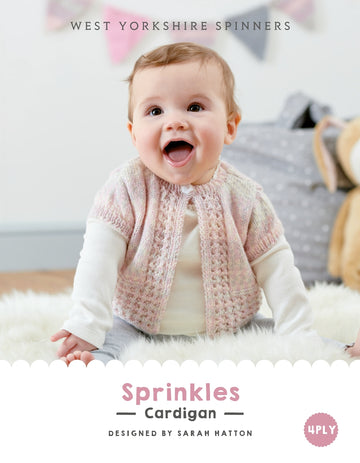 Sprinkles Cardigan in West Yorkshire Spinners Bo Peep 4 Ply - DBP0021 - Downloadable PDF
€0,00
Sprinkles Cardigan in West Yorkshire Spinners Bo Peep 4 Ply - DBP0021 - Downloadable PDF
€0,00
 Pipkin Round-Neck Cardigan in Rowan Pure Wool Worsted
€0,00
Pipkin Round-Neck Cardigan in Rowan Pure Wool Worsted
€0,00


